Handling Last-Minute Bookings Without Stressing Your Cleaners

TurnoverPing Team

Your phone buzzes at 9am. A guest just booked your property for tonight. Check-in is at 3pm. Your cleaner's schedule is already full.
This is the reality of last-minute Airbnb bookings. They represent some of your highest-margin reservations since they fill gaps other guests passed on. But they also create the most stress for your cleaning operation.
The hosts who thrive with instant bookings and short-notice reservations don't scramble every time one comes in. They have systems in place that handle the urgency without burning out their cleaners or compromising quality.
This guide shows you exactly how to build those systems.
Key Takeaways
- ✅ Last-minute bookings require a dedicated rapid-response cleaner network
- ✅ Pre-staged supplies and always-ready properties eliminate preparation time
- ✅ Premium pay for short-notice work keeps cleaners motivated and available
- ✅ Automated notifications ensure no last-minute booking catches your team off guard
- ✅ Clear booking restrictions during peak periods prevent impossible situations
Never Miss a Last-Minute Booking
TurnoverPing instantly notifies your cleaners the moment a booking is confirmed. Even same-day reservations trigger immediate alerts to your team.
Why Last-Minute Bookings Are Challenging
Short-notice turnovers push every part of your cleaning operation to its limits. Understanding why helps you build systems that actually work.
The Time Compression Problem
A normal booking gives you days or weeks of lead time. You can schedule cleaners in advance, coordinate with their other commitments, and arrange for supplies.
A last-minute booking compresses all of this into hours. Your cleaner might be in the middle of another job. Supplies might need restocking. The previous guest might not have checked out yet.
Every minute of buffer you normally rely on disappears.
Cleaner Availability Is Unpredictable
Your primary cleaner has their own life. They might be at a dentist appointment, picking up kids from school, or already committed to another property.
When you need someone in 4 hours instead of 4 days, availability becomes a gamble. The hosts who win this gamble aren't lucky. They have systems that increase their odds dramatically.
Quality Suffers Under Pressure
A rushed cleaner makes mistakes. They skip the details guests notice: water spots on mirrors, crumbs in cupboards, hair on bathroom floors.
According to Airbnb's hosting guidelines, cleanliness consistently ranks as one of the most important factors in guest satisfaction. A single bad review from a rushed cleaning can tank your occupancy for months.
Cleaners who are constantly asked to drop everything for emergency jobs eventually quit. The visible cost is messing up today's turnover. The hidden cost is losing a reliable cleaner entirely.
Coordination Overhead Multiplies
For a normal turnover, you might send one message to your cleaner days in advance. For a last-minute booking, you might make five phone calls, send ten messages, and still feel uncertain whether everything is handled.
This overhead is exhausting. It's also avoidable with the right systems.
The Last-Minute Booking Toolkit
Before you can handle short-notice turnovers smoothly, you need the right foundation in place.
Always-Ready Properties
The best way to handle last-minute bookings is to keep your properties nearly guest-ready at all times.
After every checkout:
- Full cleaning and staging completed
- All consumables restocked
- Linens fresh and beds made
- Thermostat set to a neutral temperature
When a property is always ready, a last-minute booking only requires a final inspection rather than a full turnover. If you're working with a reliable cleaning checklist, your properties should already meet this standard.
Pre-Positioned Supplies
Never run out of toilet paper during a rush turnover.
Keep a backup stock at each property:
- Extra sets of sheets and towels
- Spare toiletries and consumables
- Cleaning products that rarely need restocking
When your cleaner arrives for an emergency turnover, everything they need is already there. No store runs. No delays.
Quick-Access Checklists
A cleaner handling an emergency turnover needs clear, concise instructions. They don't have time to review detailed manuals.
Create a condensed checklist specifically for short-notice turnovers:
- Must-do items only
- In order of importance
- Time estimates for each section
If the cleaner only has 90 minutes, they know exactly which tasks to prioritize.
Create Your Emergency Cleaning Checklist
TurnoverChecklist.com generates customizable checklists for any property. Create a streamlined version specifically for short-notice turnovers.
Building a Quick-Response Cleaner Network
Your primary cleaner won't always be available for last-minute work. You need a network of backup cleaners who are specifically incentivized for short-notice jobs.
Recruiting Emergency Backup Cleaners
Look for cleaners with flexible schedules:
- Part-time cleaners who appreciate extra work
- Retired cleaners who can pick up occasional jobs
- Freelance cleaners who aren't committed to a single employer
- Local cleaning companies that take overflow work
Interview specifically for last-minute availability. Ask: "If I called you at 10am needing a turnover by 2pm, how often could you say yes?"
Onboarding for Speed
Backup cleaners need to know your properties before an emergency happens. Schedule walk-through cleanings during normal booking gaps.
During onboarding:
- Tour each property with the cleaner
- Show them where supplies are stored
- Review your quick-access checklist
- Have them complete a supervised practice turnover
When the emergency call comes, they already know exactly what to do. This preparation connects directly to a solid turnover SOP that standardizes your cleaning process.
Premium Pay for Short Notice
Last-minute work is worth more to you because it captures revenue you'd otherwise lose. Pay accordingly.
Consider:
- 25-50% premium for same-day turnovers
- 15-25% premium for next-day turnovers
- Flat bonus for accepting jobs with less than 4 hours notice
This premium serves two purposes: it compensates cleaners fairly for disrupting their schedules, and it incentivizes them to keep availability open for your properties.
Maintaining Relationships
Emergency cleaners who feel exploited won't be available for long. Protect these relationships:
- Only call on true emergencies, not poor planning
- Express genuine gratitude every time
- Pay premiums without negotiation
- Give them first right of refusal on regular work when available
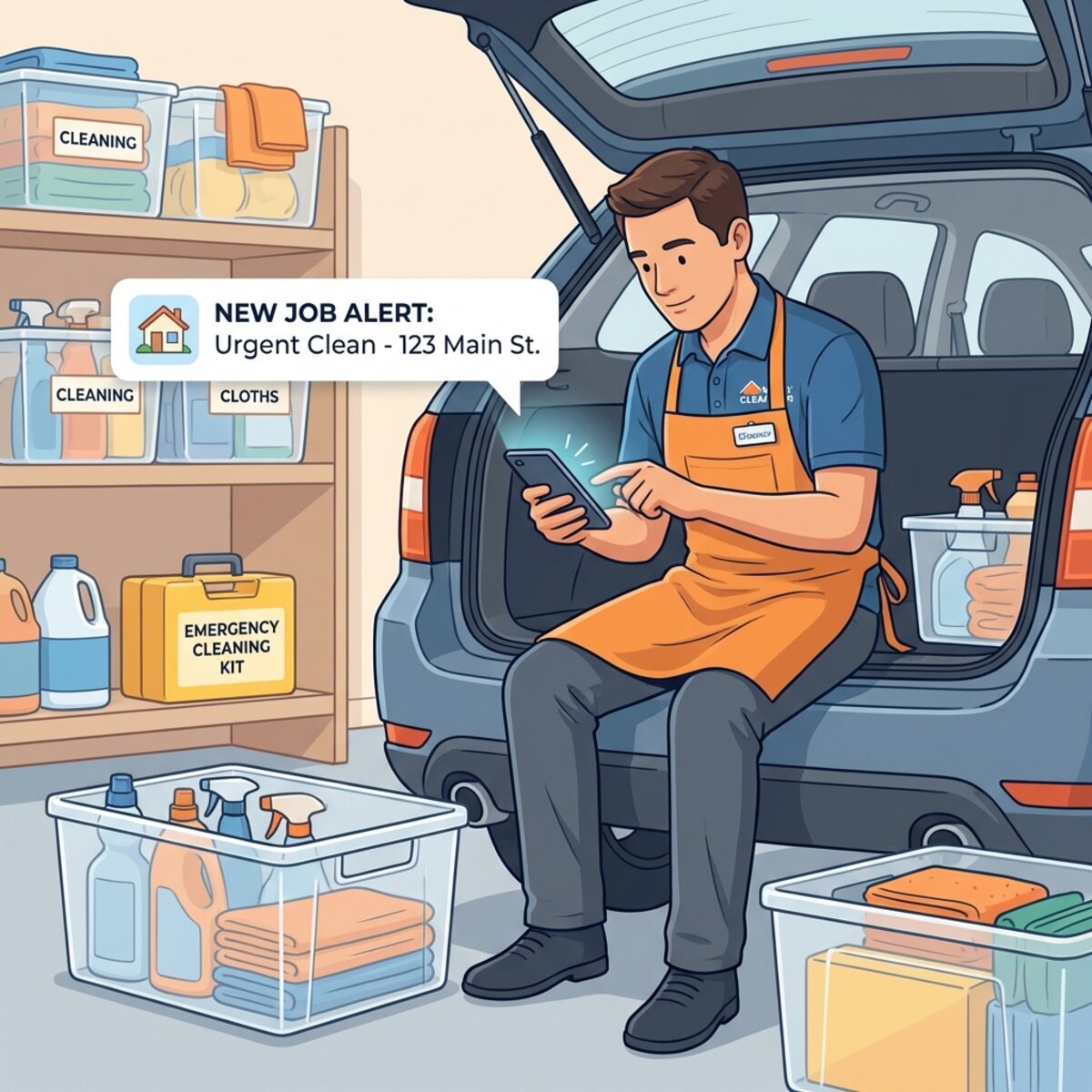
Streamlining Emergency Turnovers
When a last-minute booking comes in, every minute counts. Here's how to make the most of limited time.
The 90-Minute Emergency Protocol
When time is extremely tight, focus on what guests notice most:
First 30 minutes: Bathrooms and kitchen
- Toilets, sinks, showers spotless
- Fresh towels staged
- Kitchen surfaces wiped down
- Trash emptied
Next 30 minutes: Bedrooms
- Fresh linens on beds
- Surfaces dusted
- Floors vacuumed
Final 30 minutes: Living areas and finishing touches
- Quick vacuum and tidy
- Thermostat adjusted
- Lights positioned
- Final walkthrough
This protocol covers the essentials. A guest might notice minor dust in a corner, but they'll definitely notice a dirty bathroom.
Skip the Laundry Cycle
The biggest time waste in emergency turnovers is waiting for laundry. Have backup linens ready at every property.
Standard flow:
- Strip beds and load washing machine
- Wait 45-60 minutes for wash cycle
- Wait 45-60 minutes for dry cycle
- Make beds
Emergency flow:
- Strip beds
- Make beds with backup linens
- Bag dirty linens for later processing
You've just saved 90-120 minutes. Process the dirty linens after the guest checks in or during your next regular turnover.
Parallel Processing
If you have two backup cleaners available, deploy both:
- Cleaner 1: Bathrooms and bedrooms
- Cleaner 2: Kitchen and living areas
What takes one person 3 hours takes two people 90 minutes. For high-value last-minute bookings, the cost of two cleaners is worth capturing the reservation.
Keep a network of at least 3-4 backup cleaners per market. Even if your primary is unavailable, odds are at least one backup can step in. This redundancy is essential for handling same-day turnovers reliably.
Setting Boundaries That Protect Everyone
Not every last-minute booking is worth accepting. Strategic limits protect your cleaners and your quality standards.
Minimum Turnaround Windows
Set platform-level restrictions that give you breathing room:
On Airbnb:
- Go to Calendar > Availability Settings
- Set "Advance Notice" to a minimum number of hours (e.g., 6-12 hours)
- This prevents bookings that create impossible cleaning windows
On VRBO and Booking.com: Similar settings exist under "Rules" or "Policies."
A 6-hour minimum gives you time to confirm cleaner availability before the booking is locked in. For specific guidance on handling bookings across multiple platforms, check our Booking.com guide.
Peak Period Blocks
During high-demand periods, block turnover days to prevent compressed schedules:
- Holiday weekends: Require 2-night minimum stay
- Summer peak: Add preparation time between bookings
- Festival or event dates: Manual approval only
These restrictions slightly reduce occupancy but dramatically reduce stress on your cleaning team.
Declining Gracefully
Sometimes the right answer is saying no to a last-minute booking. Build a cancellation buffer:
If you accept a same-day booking and then can't get a cleaner, you face a host cancellation penalty. Better to have platform settings that prevent bookings you can't serve.
For truly impossible situations, contact the guest immediately, explain the situation, and offer alternative dates. Honesty prevents bad reviews.
Automating Short-Notice Coordination
Manual coordination is the weakest link in last-minute turnovers. By the time you've texted three cleaners and waited for responses, an hour has passed.
Automation removes this delay entirely.
Instant Booking Notifications
When a booking syncs from your calendar, your cleaner should know immediately. Not when you check your phone. Not when you remember to text them. Immediately.
Automated systems detect the booking and send notifications within minutes.
For last-minute bookings, this early notification is the difference between success and scrambling.
Automatic Backup Escalation
If your primary cleaner can't take the job, automation handles the handoff:
- Primary cleaner receives notification
- Primary declines or doesn't respond within time limit
- Backup cleaner receives notification automatically
- Process continues until someone accepts
No phone calls. No manual texts. No wasted time. This backup logic is exactly what TurnoverPing provides out of the box.
Multi-Channel Reach
Your cleaner might not check email during a busy morning. But they might see a text. Or a WhatsApp message.
Automation sends notifications across multiple channels based on cleaner preference. The message reaches them on whatever platform they actually check.
Track All Your Last-Minute Bookings
RentalReportDaily.com sends a daily digest of all your reservations across Airbnb, VRBO, and Booking.com. See what's coming so you're never caught off guard.
Confirmation Tracking
Did your cleaner see the notification? Did they accept? Did they decline?
With manual coordination, you don't know until you follow up. With automation, you see confirmation status in real time.
For last-minute bookings, this visibility is critical. An unconfirmed same-day turnover is a red alert. An unconfirmed turnover next week is merely a reminder.
Creating a Last-Minute Booking Playbook
Document your short-notice process so anyone on your team can execute it:
Step 1: Immediate Notification (0-15 minutes)
- Booking confirmed triggers automatic cleaner notification
- You receive confirmation that notification was sent
- Track whether cleaner has responded
Step 2: Backup Activation (15-60 minutes)
- If primary can't accept, backup is automatically notified
- If no backup available, you're alerted
- Begin manual outreach only if automation fails
Step 3: Preparation (1-4 hours before clean)
- Confirm previous guest has departed
- Verify supplies are stocked
- Send any special instructions
Step 4: Turnaround (During cleaning)
- Cleaner follows emergency checklist
- Photos taken of completed work
- Confirmation sent when property is ready
Step 5: Guest Arrival
- Final walkthrough if time permits
- Check-in instructions sent automatically
- You monitor for issues
This playbook turns chaos into a repeatable process. For effective cleaner communication templates to use throughout this process, see our dedicated guide.
Measuring Last-Minute Performance
Track how well your short-notice system performs:
Key Metrics
Acceptance rate: What percentage of last-minute jobs are your cleaners accepting?
- Target: 90%+ for same-day bookings
Fill time: How long from booking to confirmed cleaner?
- Target: Under 30 minutes for same-day
Quality score: How do guests rate cleanliness on short-notice turnovers?
- Target: Equal to your regular turnover ratings
Cleaner retention: Are your emergency cleaners staying long-term?
- Target: Less than 20% annual turnover
Improving Over Time
If acceptance rates are low, cleaners might need better incentives or you might be asking too often.
If fill times are slow, you might need more backup cleaners or faster notification systems.
If quality scores drop on emergency turnovers, your quick-access checklists might need refinement.
Measure, adjust, improve.
Conclusion
Last-minute Airbnb bookings represent some of your highest-value reservations. They fill calendar gaps that would otherwise sit empty. But they also test your cleaning operation more than any other booking type.
The hosts who capture this revenue without burning out their cleaners have built systems that work:
- Always-ready properties that need minimal preparation
- A dedicated network of backup cleaners incentivized for short notice
- Premium pay that compensates for schedule disruption
- Emergency checklists that prioritize what guests notice most
- Automated notifications that eliminate coordination delays
- Strategic booking limits that prevent impossible situations
With these systems in place, a last-minute booking becomes an opportunity instead of a crisis. You accept the reservation knowing that your team can deliver the same quality in 4 hours that they normally deliver in 4 days.
Start by recruiting two backup cleaners this week. Give them premium rates for short-notice work. Create your emergency checklist. Then let automation handle the coordination.
Last-minute bookings don't have to stress your cleaners. They can become one of your most reliable revenue streams.
Frequently Asked Questions
How much should I pay cleaners for last-minute turnovers?
Should I turn off instant booking to avoid last-minute reservations?
How many backup cleaners do I need for last-minute coverage?
What if no cleaner is available for a same-day booking?
Can automation really help with last-minute bookings?
Automate Your Last-Minute Turnovers
TurnoverPing syncs with your booking calendar and notifies your cleaners instantly, even for same-day reservations. Backup logic ensures every turnover is covered automatically.
Related Articles

How to Organize Linen and Laundry for Multiple Properties
Master the art of linen inventory and laundry logistics across multiple vacation rentals. Learn the 3-set system, professional laundry strategies, and how to keep every property guest-ready without the chaos.

Airbnb Cleaning Checklist for Small Studios and Tiny Spaces
Master the art of cleaning compact vacation rentals. This checklist covers studio apartments, tiny homes, and small spaces where every minute and every square foot counts.

Best Practices for Sharing Calendar Access with Your Cleaners
Discover the safest, most effective ways to share your Airbnb, VRBO, and Booking.com calendars with your cleaning team. Stop micromanaging and start automating.